
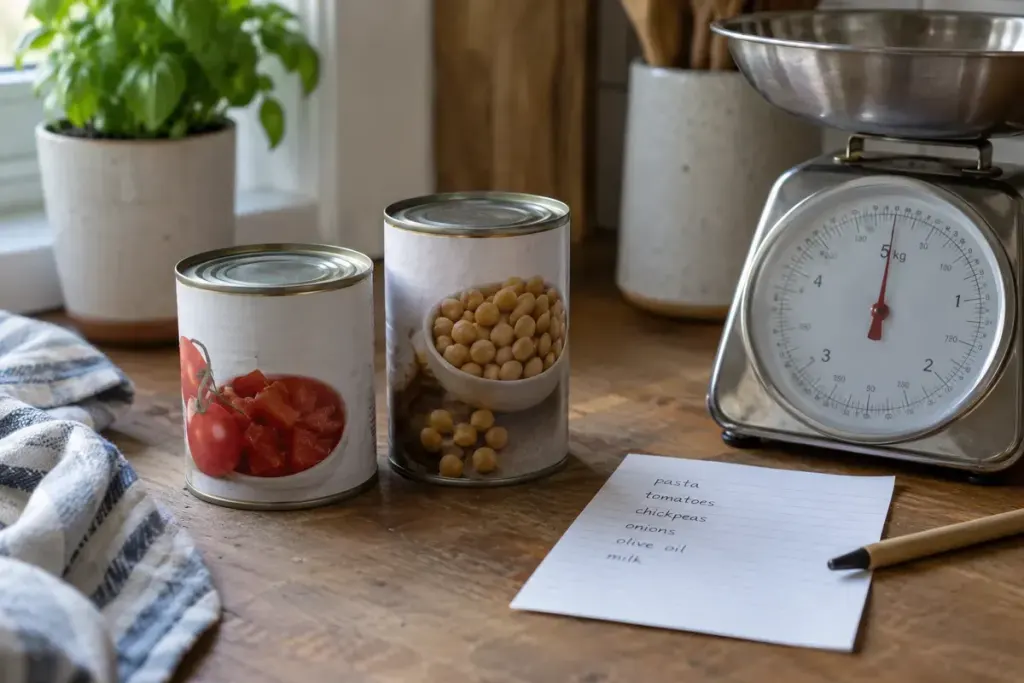
Two tins can carry the same headline weight while leaving different amounts of food in the colander. Beans in liquid, fruit in syrup, and fish in brine make the distinction visible: the contents you buy are not always the same quantity as the ingredient you put into a recipe.
Look for both net weight and drained weight where provided. Net weight includes the product’s packing liquid; drained weight describes the solid food after the specified draining process. Check the actual label rather than assuming every product displays both in the same position.
Choose the quantity that matches your use
If you drain the liquid away, the drained amount is a useful basis for your own comparison. If you use the liquid in the dish, that changes the practical value. A smaller solid portion is not automatically a worse purchase when the whole contents serve your purpose.
Consider a fictional tin costing 1.20 with 240 grams drained, and another costing 1.40 with 300 grams drained. The first costs 0.50 per 100 grams of drained food; the second costs about 0.47. These are illustrative prices, not current shop offers.
Check what the shelf comparison measures
A displayed unit price may use a basis that is not obvious at a glance. Read the unit and the packaging information before comparing it with your calculation. Labelling rules and shop practices vary by location, so do not assume the same basis applies everywhere.
Then check the recipe quantity. If one tin leaves an awkward amount you are unlikely to use, a slightly different size may fit the meal better. Keep nutrition, ingredients, and dietary needs in the decision too; equal drained weights do not make different foods interchangeable.
A quick note of the product, usable quantity, and price can make repeat shopping easier. It is more informative than remembering that one tin was “bigger,” especially when a label redesign moves the most prominent number.