
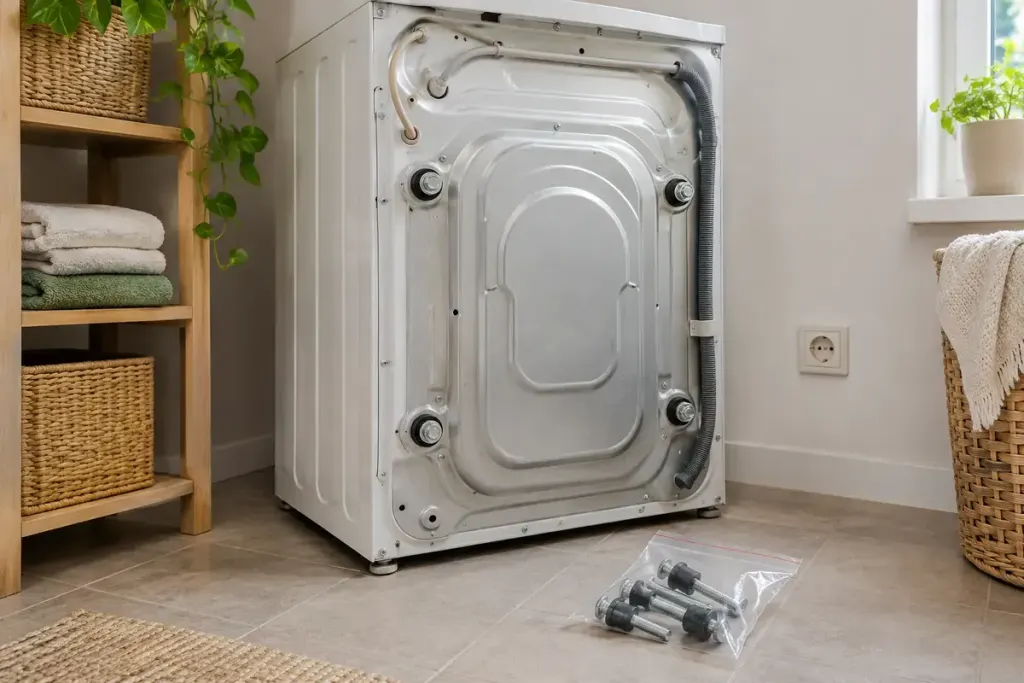
A newly installed washing machine starts shaking violently, and the first assumption is that its feet need adjustment. That may be part of the installation check, but transport restraints deserve attention first. These parts secure the suspended assembly for movement; they are not meant to remain engaged during normal washing.
Bosch’s transport-lock guidance explains the purpose of removing the relevant restraints before use. The precise parts and removal procedure depend on the model, so the installation manual should identify them. Do not decide that every bolt visible on the back must come out.
Before the first cycle
Find the model number and its matching installation instructions. Check the transport-restraint section along with positioning, levelling, connections and any commissioning procedure. If a delivery team installed the appliance, ask it to confirm that the specified restraints were removed and where they were placed.
Keep the removed parts together, labelled with the appliance model, in a location you can find before moving home. Include any sleeves or spacers identified by the manual. A bag containing only the most obvious bolts may be incomplete.
Do not run repeated spin cycles to see whether severe shaking settles down. Stop using the appliance and have the installation checked if it moves abnormally, makes concerning noises or appears unsafe. Transport restraints are one possible cause, not a remote diagnosis of every vibration problem.
Before the next move
Look up the manufacturer’s preparation procedure early enough to obtain missing parts. For example, a Bosch installation manual includes model-specific transport preparation. Use the manual for your own appliance rather than transferring the illustrated bolt count or position to another machine.
Arrange competent help for heavy lifting and any plumbing or electrical work that you cannot safely undertake. Reinstalling restraints, draining residual water and securing hoses are separate steps; completing one does not mean the machine is ready for every type of transport.
A short note in your moving checklist can prevent a repeat problem: “Transport parts fitted for move; remove according to manual at destination before operation.” Photographing the labelled bag is useful too. The small saving comes from keeping the correct parts and instructions available, rather than buying replacements under pressure on moving day.