
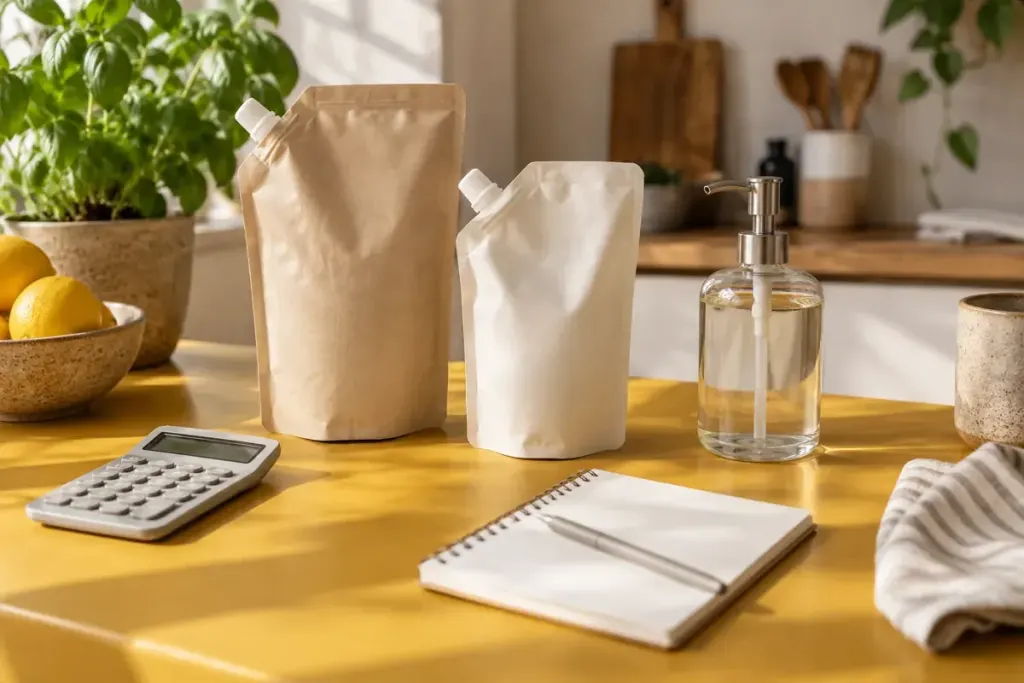
A large refill pouch carries a smaller price on the shelf, so it feels like the obvious bargain. But the smaller bottle next to it may contain a different concentration, and the pouch may not fit the dispenser you already own. A useful comparison needs more than the largest number on the front.
Start by comparing the same kind of product in the same unit. Then ask whether the lower-priced quantity will actually be used in your household.
Put both prices on the same basis
Divide the purchase price by the quantity, then express both results per litre, kilogram or another matching unit. The UK’s consumer guide to unit pricing explains how shelf unit prices can help compare different pack sizes. Labelling rules vary by country, but the arithmetic is the same.
For an invented example, a 500 ml product costs 3.00 currency units and a comparable 900 ml refill costs 4.50. The first costs 0.60 per 100 ml; the second costs 0.50 per 100 ml. The refill is cheaper per unit in this example, even though its total price is higher. These are illustrative figures, not current shop prices.
Check whether the contents are comparable
A ready-to-use liquid and a concentrate are not directly comparable by their package volume alone. Read the maker’s dilution or dosing instructions and consider the stated usable quantity. Do not invent a stronger or weaker mixture to make the calculation look attractive.
Likewise, compare products that perform the same job. A different formulation, scent, material compatibility or use restriction may matter more to your household than a small unit-price difference. Follow the manufacturer’s instructions and do not mix cleaning products or transfer them into misleading containers.
Count the quantity you can realistically use
Buying more only saves money if the purchase fits your needs and storage conditions. Ask how quickly you use the product, whether it has a relevant use period and whether you have a suitable place to keep it safely. A leaking pouch or an unsuitable dispenser can turn an apparent saving into waste.
Check the total transaction too. A discount requiring several packs, an extra delivery charge or a minimum order may change the comparison. Write down the final amount you would actually pay, not only the promotional headline.
Keep one simple comparison note
If you buy the same household item regularly, record the pack size, price and date for your own reference. This is a personal record, not a market price index. It helps you notice when a package becomes smaller or a familiar promotion is less useful than expected.
Choose the option that works for the household, even if it is not the lowest unit price. A smaller affordable purchase that you can store and use can be more practical than a bulk bargain that does not fit your space or routine.