
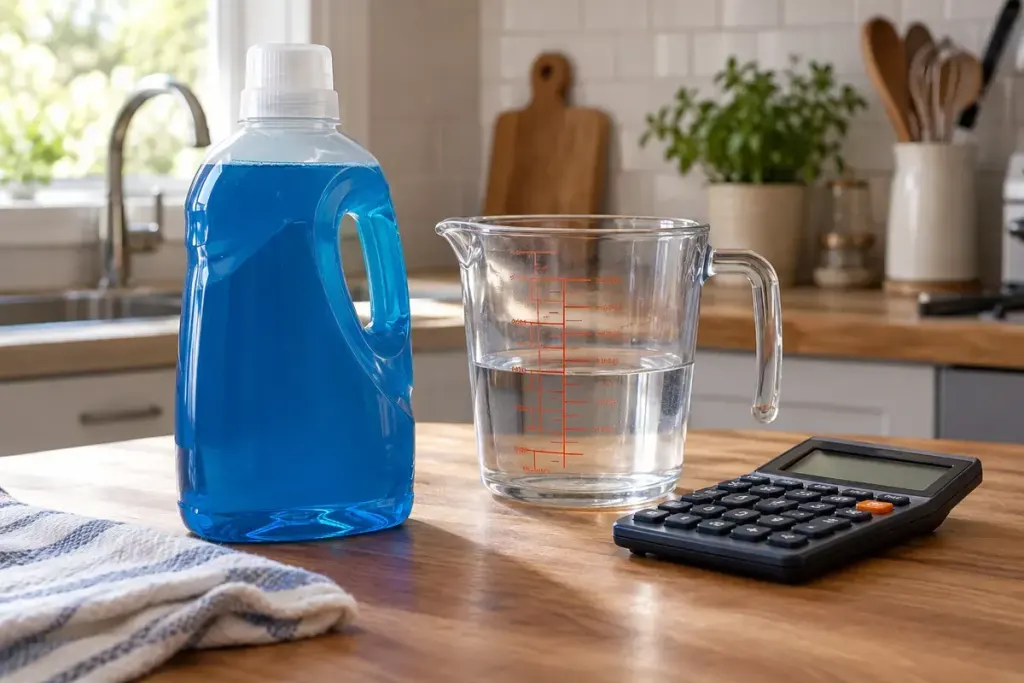
A small bottle of concentrate can look expensive beside a large ready-to-use product. Bottle volume alone does not settle the comparison. The more useful question is how much usable product the labelled directions produce for the same job.
Start with the exact use you need. Some concentrates have different directions for different tasks, so a maximum-yield claim may not describe your intended use. Compare like with like: the same purpose, a suitable product and the manufacturer’s specified dilution or dose.
Work through one invented example
Suppose a fictional 500 ml concentrate costs 8 currency units and its label specifies 10 ml for each completed batch. That provides 50 batches, making the concentrate cost 0.16 per batch. A second product costing 6 units for 30 equivalent batches would cost 0.20 per batch. These are illustrative numbers, not directions for any real chemical or a current price comparison.
Check what “one litre” or another batch size means in the actual instructions. Adding concentrate to a stated volume of water is not necessarily the same instruction as making the mixture up to a stated final volume. Do not resolve unclear directions by guessing; ask the manufacturer.
Include practical waste in your decision. A product is less economical if the measuring arrangement causes frequent overuse or if you prepare more than can be used within its stated storage conditions. Keep the original label and use suitable dedicated equipment, not a drinking vessel that could later be confused with kitchenware.
Never mix cleaning products or increase concentration to make the arithmetic look better. Follow the product’s handling, ventilation, storage and surface-compatibility instructions. A cheaper calculated batch is not useful if the product is unsuitable for the task.
Write the final comparison as price per labelled use, with the assumptions beside it. That small note makes the calculation repeatable when the pack size, price or instructions change, and avoids treating the biggest bottle as automatically the best value.