
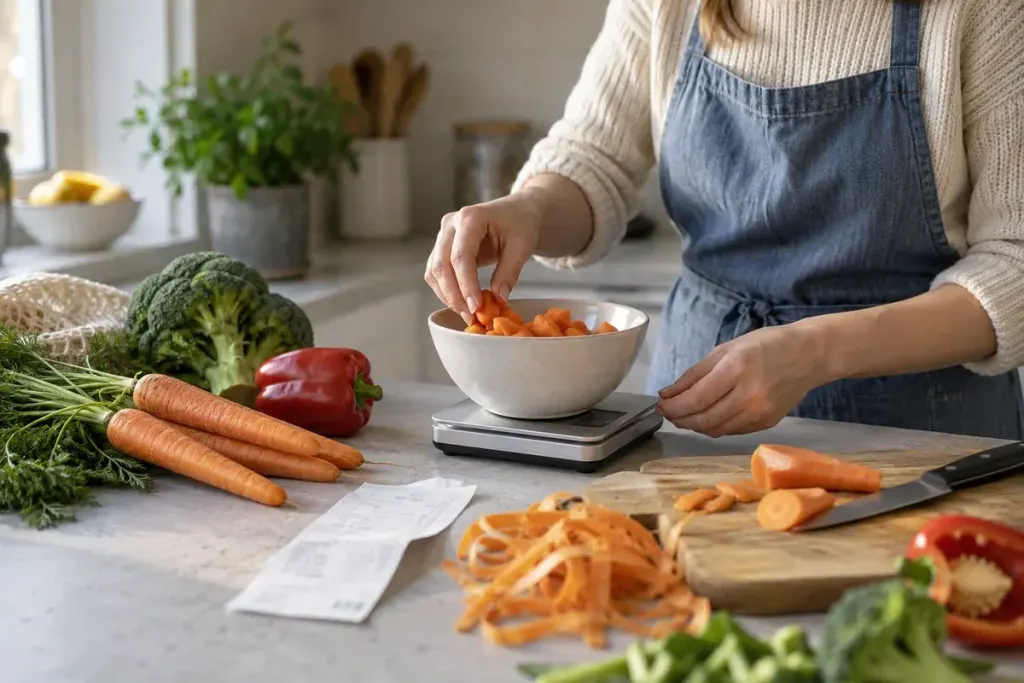
The larger pack has the lower price per kilogram, so it looks like the obvious bargain. By the end of the week, part has spoiled and another portion is still waiting for a recipe you never had time to make.
Unit price is useful, but the household ultimately pays for food it buys, not only food it eats. A second calculation asks how much the purchase costs per usable portion in your actual routine.
Estimate the amount that reaches the plate
Allow for bones, peel, trimming or draining where relevant. Do not treat every scrap as waste; some can be safely used in other dishes. The point is to compare like with like, not to reward the option with the heaviest packaging or inedible parts.
As a simple illustration, a six-unit purchase that provides three meals costs two units per meal. A five-unit purchase that reliably provides four meals costs 1.25 units per meal. These fictional numbers demonstrate the method; they are not local price estimates.
Include the chance that plans change
Ask whether the food will keep until you use it and whether you have suitable freezer space. A bulk purchase can work well when portions are planned and stored correctly. It can be poor value when it depends on several ambitious cooking sessions during a busy week.
USDA MyPlate’s budget guidance offers planning resources for affordable eating. Adapt suggestions to local food availability, dietary needs and safe storage guidance rather than assuming one shopping pattern suits every household.
Count effort without pretending it has one universal price
Prepared ingredients may cost more on the shelf but make a home-cooked meal feasible on a difficult day. Whole ingredients may be better value when you have time, equipment and a reliable use for the remainder.
Try comparing two options for one repeated meal. Record the purchase cost, portions actually eaten and preparation effort. Avoid tracking every gram indefinitely; a short observation is often enough to reveal a pattern.
Buy for the week you have
Before choosing the biggest pack, check the calendar and what is already available at home. A smaller quantity used completely can be the economical choice even when its unit price is higher.
The best basket is not always the one with the lowest total at checkout. It is the one that turns into meals you can realistically prepare, store and enjoy without paying again for food that never reaches the table.